
Monarch Watch is an education, conservation, and research program based at the University of Kansas that focuses on the monarch butterfly, its habitat, and its spectacular fall migration. Monarch Watch was founded in 1992 by Dr. Orley "Chip" Taylor and the monarch tagging program was launched in the fall of that year.
Mission Statement: Monarch Watch strives to provide the public with information about the biology of monarch butterflies, their spectacular migration, and how to use monarchs to further science education in primary and secondary schools. We engage in research on monarch migration biology and monarch population dynamics to better understand how to conserve the monarch migration. We also promote protection of monarch habitats throughout North America.
Vision Statement: In recognition of the rapid loss of habitats and resources needed by monarch butterflies in the United States, Canada, and Mexico, it is clear that the preservation of the monarch migration will require stewardship by the governments and private citizens of all three countries. We all must work together to create, conserve, and protect monarch habitats. Sustaining monarch habitats will have the effect of protecting vital pollinators and other wildlife.
|
|
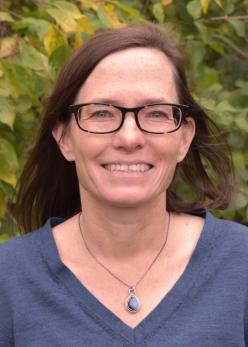 Kristen A. Baum [kbaum@ku.edu] Kristen A. Baum [kbaum@ku.edu]
Director of Monarch Watch; Senior Scientist, Kansas Biological Survey & Center for Ecological Research; Professor of Ecology & Evolutionary Biology, University of Kansas, Lawrence, KS.
Prior to assuming the role of Monarch Watch Director in 2023, Baum was a professor in the Dept. of Integrative Biology and associate dean for research at the College of Arts and Sciences at Oklahoma State University.
Baum has worked with monarchs and other pollinators in the Great Plains for more than 25 years. Her monarch research focuses on the effects of land use and management practices on the distribution and abundance of monarchs, milkweeds, and monarch-parasite interactions. She also has a long-term project focusing on the wing size, body weight, sex ratio, and OE infection status of fall migrants in Oklahoma. Baum has served on numerous state, regional and national working groups to support conservation efforts for monarchs and other pollinators.
Additional links:
• Monarch Watch welcomes a new director, Dr. Kristen Baum (article)
• Kristen Baum will lead Monarch Watch (article)
• Kristen Baum takes the reins as new director of Monarch Watch (article)
• Kristen A. Baum: Kansas Biological Survey & Center for Ecological Research (bio)
• Dr. Kristen Baum: University of Kansas Department of Ecology & Evolutionary Biology (bio)
• Kristen A. Baum: Google Scholar (profile)
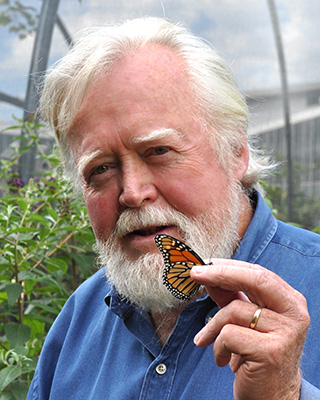 Orley R. "Chip" Taylor [chip@ku.edu] Orley R. "Chip" Taylor [chip@ku.edu]
Founding Director of Monarch Watch; Professor Emeritus of Ecology & Evolutionary Biology, University of Kansas, Lawrence, KS.
Trained as an insect ecologist, Taylor has published papers on species assemblages, hybridization, reproductive biology, population dynamics and plant demographics and pollination. Starting in 1974, Taylor established research sites and directed students studying Neotropical African honey bees (killer bees) in French Guiana, Venezuela, and Mexico.
In 1992, Taylor founded Monarch Watch, an outreach program focused on education, research and conservation relative to monarch butterflies. Since then, Monarch Watch has enlisted the help of volunteers to tag monarchs during the fall migration. This program has produced many new insights into the dynamics of the monarch migration. In the fall of 2023, Taylor stepped away from day-to-day operations of the program to focus on the completion of several monarch projects.
 Jim Lovett [jlovett@ku.edu] Jim Lovett [jlovett@ku.edu]
Research Project Coordinator
Jim earned bachelor's degrees in Biology at the University of Kansas and began working for Monarch Watch in 1995. He is primarily responsible for managing Monarch Watch's technology (hardware, software, services, and data) but also provides technical and other support for all ongoing projects and program activities through financial reporting, fundraising, marketing, promotion and communication with the public and media outlets.
 Ann Ryan [annryan@ku.edu] Ann Ryan [annryan@ku.edu]
Research Project Manager
Ann received a bachelor's degree in Biology from the University of Kansas and began working for Monarch Watch in 2006. She is the office manager for the program, coordinates the monarch tagging research program, hires and supervises all student workers, manages the insect laboratory and plants, and serves as our outreach coordinator.
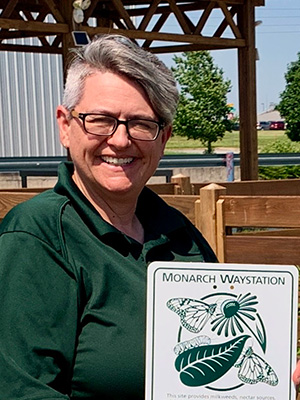 Dena Podrebarac [denap@ku.edu] Dena Podrebarac [denap@ku.edu]
Milkweed Coordinator
After earning her bachelor's and master's degrees in Biology from Emporia State University, Dena began her professional career as a summer Naturalist for the Kansas Department of Wildlife and Parks for two years and as adjunct faculty for Highland Community College. She then worked in the Public Education Department at The University of Kansas Natural History Museum for many years. After taking a break to be a stay-home mom, she returned to KU to work at Monarch Watch in 2016. Dena's main duties include administering three milkweed distribution programs and the milkweed seed bank.
 Jess Anderson [jessica.anderson@ku.edu] Jess Anderson [jessica.anderson@ku.edu]
Communications Coordinator
Jess was born and raised on the East Coast and earned her bachelor's degree in communications from Susquehanna University. In 2017, she put down roots in the Midwest and began her career as an editor for sustainable-lifestyle magazines at Ogden Publications. Her focuses included editing print and online articles, producing podcast episodes, and developing content for a variety of platforms. She joined the Monarch Watch team in 2024 and works to help develop, distribute, and promote content and events concerning the monarch butterfly and Monarch Watch's efforts for education, conservation, and research.
|
 We're in the business of sharing knowledge, so it's important that you know how to connect with us and access information. There are several ways to do this: We're in the business of sharing knowledge, so it's important that you know how to connect with us and access information. There are several ways to do this:
EMAIL UPDATES: monarchwatch.org/subscribe
EMAIL DISCUSSION LIST: monarchwatch.org/dplex
BLOG: monarchwatch.org/blog
FACEBOOK: @monarchwatch
INSTAGRAM: @monarch_watch
DONATE: monarchwatch.org/donate
MONARCH WATCH SHOP:
Visit the Monarch Watch Shop (shop.monarchwatch.org) online to order tagging materials, rearing materials, books, posters, tshirts, and more!
If you have questions about ordering or about an order you have already placed, please contact the Monarch Watch Shop at mwshop@monarchwatch.org or 800-780-9986
Offline orders via mail, phone, or fax may be directed to the Monarch Watch Shop at:
Monarch Watch Shop
c/o Nonprofit Business Solutions
2701 Centerville Rd.
Wilmington, DE 19808
toll-free phone: 800-780-9986
toll-free fax: 877-687-4878
MILKWEED MARKET:
Visit the Monarch Watch Milkweed Market (shop.milkweedmarket.org) online to order flats of milkweed plugs for gardens or restoration projects.
Any questions about your Milkweed Market order may be directed to us at monarch@ku.edu or 785-864-4441 and additional information is available at monarchwatch.org/milkweed/market/
GENERAL CONTACT: for general information, questions, and comments, please use the following to contact Monarch Watch:
Monarch Watch
University of Kansas
2021 Constant Ave
Lawrence, KS 66047 U.S.A.
785-864-4441
monarch@ku.edu
monarchwatch.org
|
|
If you enjoy the various educational, conservation, and research programs Monarch Watch offers throughout the year, please consider making a donation today - it's quick, easy, secure, and fully tax-deductible. You can even set up a recurring gift (monthly or annually) if you'd like. We rely on contributions from Monarch Watchers just like you to keep the program going - thank you for your continued support!

If you would rather mail in a donation or have questions, please visit Giving in Support of Monarch Watch.
|